Retraining Diaphragmatic Breathing: The Tactile Biofeedback Method

 Most people trying to fix shallow breathing make the exact same mistake: they force their stomach out.

​Deliberately pushing the abdominal wall forward engages the abdominal muscles rather than relaxing them. True diaphragmatic breathing is not a muscular push; it is an expansion caused by the downward excursion of the diaphragm, which naturally displaces the abdominal organs.

​Because the diaphragm sits inside the lower rib cage and lacks direct sensory visibility, commanding it to move rarely works. What does work is tactile biofeedback—giving your nervous system an external physical reference point to respond to. A single hardcover book is often all you need


​Why External Weight Works: The Physiology

​Using a small amount of weight on the abdomen alters how the central nervous system perceives respiration:

  • ​Sensory Mapping via Mechanoreceptors: Placing a flat, mild resistance across the abdomen activates cutaneous and fascial mechanoreceptors. This gives the somatosensory cortex an immediate geographical target, allowing the diaphragm to contract efficiently without recruiting accessory muscles in the neck or upper chest.
  • ​Vagal Nerve Stimulation: As the diaphragm descends under this gentle resistance, it creates rhythmic intra-abdominal pressure changes. These pressure shifts stimulate the abdominal branches of the vagus nerve, signaling the parasympathetic branch of the autonomic nervous system to reduce heart rate and lower systemic cortisol levels.
  • ​Inhibiting Neck and Shoulder Tension: Chronic chest breathers overwork their scalenes, sternocleidomastoid, and upper trapezius muscles. Working supine with a weighted cue encourages these cervical muscles to stay silent, shifting mechanical work back to the primary respiratory engine.
  • ​Hemodynamic and Visceral Mobilization: The gentle oscillation against resistance massages the internal organs, assisting venous return toward the heart and promoting healthy peristaltic activity in the digestive tract.

​The Drill: Step-by-Step Protocol

​1. Constructive Rest Setup

​Lie on your back on a firm mat or carpet. Bend your knees, placing the soles of your feet flat on the floor, roughly hip-width apart. Keeping the knees bent is essential: it takes tension off the psoas major and the abdominal wall, allowing the pelvis to rest in a neutral position.

​2. Positioning the Book

​Place a thick hardcover book (a dictionary or substantial novel) across your abdomen, centered over the navel. Rest your arms comfortably by your sides, palms facing upward, with your shoulders completely relaxed.

​3. The Inhalation (Ascent)

​Inhale smoothly and quietly through the nose. Do not attempt to take a massive gulp of air. Simply allow the incoming air to expand the lower torso, letting the weight of the book lift an inch or two toward the ceiling. The movement should feel soft and effortless.

​4. The Exhalation (Descent)

​Exhale slowly and continuously through the nose (or through slightly parted lips if releasing acute tension). Do not pull your navel to your spine; let gravity bring the book down naturally as the diaphragm relaxes back into its dome shape.

​5. Duration and Pace

​Maintain this cadence for 5 to 10 minutes. Aim for a steady, unforced pace—roughly 4 to 5 seconds in and 5 to 6 seconds out.

​Common Mistakes to Watch For

  • ​Active Abdominal Pushing: The book should rise because the lungs are filling downward and expanding the abdominal cavity, not because you are flexing your core muscles outward.
  • ​Upper-Chest Leading: If your chest lifts before the book moves, you are still breathing into your upper lobes first. Downscale the breath volume: make the breath smaller and softer until only the book moves.
  • ​Hyperventilation: Diaphragmatic retraining is not about taking huge breaths. Oversized breaths purge too much carbon dioxide, causing lightheadedness and triggering mild sympathetic arousal. Keep the breath quiet, small, and continuous.
  • ​Looking for a structured daily practice?

    If you want clear, step-by-step guidance on postural alignment, breathwork, and establishing a consistent routine at home, check out my practical manual:

    ​šŸ“– Yoga at Home: A Practical Guide from Scratch — [Available on Amazon in Paperback & Kindle]

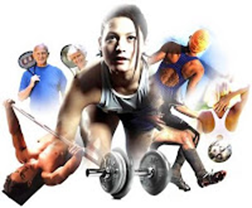
SEDENTARY LIFE, AESTHETICS, SPORTS, HEALTH ... AND YOGA


The average human being of the 21st century has a problem: if he does nothing he becomes sedentary. And it is so easy to become sedentary! And so comfortable! Just do nothing.

Why does this happen? Simply because we are a relatively young species whose technology has advanced much faster than its physical body. And it was that four days ago we lived in the caverns ... If we didn't run we wouldn't hunt and we didn't eat; if we were not agile to climb trees, we ate some predator; if we did not have physical strength we did not last many winters. That is, if we were not physically fit we would not survive.

Today, what is the need to run, hunt, climb or fight? To eat just go to the corner supermarket, go down the stairs (by elevator), walk a little (some go by car) and return with the purchase home (again by elevator). To protect us from wild animals (on two legs, because those on four are in extinction)? Nothing better than a Prosegur alarm, Securitas Direct or a fat lock. What do you have to do to be the alpha male of the tribe and secure the offspring? Nothing man, just bring out the wallet and see that it is well chubby. Anyway, what generates all this?: sedentary lifestyle . What is a sedentary lifestyle? Overweight, cholesterol, triglycerides, being more rigid than the goalkeeper of a table football and having less physical strength than Spanish justice.

How is this solved? How do you fight sedentary lifestyle? There are four options or ways:

1.- Stay as I am , but worse and worse, with the acknowledgment of the years. This is the easiest option to follow, it is like the grooves left by torrents or rivers ... When it rains the water always goes the same way because it offers the least resistance.


2.- To worry about the aesthetics without taking out the garbage can. That is, plastic surgery, some miraculous diet or exercises to lower the belly. There are also those who crush hours and hours in the gym every week doing weights and running like a chicken through Ethiopia to run out of a gram of fat and to see the "chocolate tablet"; not for clear health, but for aesthetics. 

And what is aesthetics good for? To link more ; for nothing else, make it clear. That is to say, we invest years of our life to have a fitness body with the objective that when the summer arrives we have the opportunity to take off our shirt and oh, the females fall at our feet (or if it is a woman, that the men we get torticles). The problem is that if that facade has no content ... bad matter. If we put meringue on shit, shit is still what it is: shit.


3.- Do sports , which everyone says is very good, also is very pro and gives you points for society. What an athlete you are, huh! You go to the Decathlon, you fill yourself well with breathable synthetic clothes, some running shoes (but not very expensive huh!, That our knees and hips do not deserve so much, it is only for hitting) and wing, to throw miles; to sweat like a bastard and in the middle of town, or the sports center, stop snorting and stop the clock (important that people see you making this gesture). «What athlete is X person! How do you take care of yourself! ”People will say. Thing that good, seen from a social perspective is not so bad. The problem will come when X person is fifty years old, his joints broken and his heart waving a white flag with his tongue out.

Notice for navigators: sport is not synonymous with health . The sport is fine if you get paid to do it.

That is, if you are an elite athlete (car player is the best sporting profession you can choose, for the pasta they earn) and your monthly salary derives from it. In that case, if you are shattering at fifty, you look at your checking account and say, “Well, it was worth it; excerpts from the trade, like any other ». But male! Hit you half marathons and marathons every week for hobby, I think at least masochist. If in that sucked face that you have it shows that very healthy you cannot be. The sport also ends up becoming an obsession, it becomes addictive, a drug; and really it is, since a lot of hormones are released with physical exercise that eventually make you feel bad if you fail to generate them.


Another warning for navigators: no matter how much sport we do, no matter how much we run, no matter how little fat we have and no matter how much we take care of ourselves, we will die the same. I remind you in case you had forgotten.

4.- Saint Barbara, Saint Barbara ...! How awful I am! I've seen the wolf's ears! The doctor has told me that either I take care of myself or ...! Friend, this is when you care about your health and the goal is to recover it.

-Yes, I have signed up for the gym, but both aesthetics and sporting purpose bring me carelessly, I want to be healthy.

-Okay, okay, I won't worry , let's design an exercise routine and come two or three times a week; You will see how well you are doing.


And it is true, that in months you will be much better; As you feel better, you will not remember Saint Barbara and what will happen? You will return to point 1.

Health is like repairing a machine that requires maintenance (in fact the physical body is a machine); and there are two types of maintenance: the corrective and the preventive .

People look for the corrective in 90% of the cases, that is, that it heals me, that my health problem is solved and then ... I disregard until the next repair, which will be worse and worse. Maintenance? Ufff, what sacrifice not? We better wait for it to break again and we will repair it. This is how it goes.

5.- Practice Yoga . It is that Yoga is the host, it is the best and above all, the most intelligent . At a stroke we put ourselves before the problem of sedentary lifestyle, by establishing our weekly routine. We work on movement, strength, endurance, flexibility ... and all this without forcing or damaging the physical body. We also work inside, that is, apart from covering ourselves with meringue, we purify the shit and transform it; We do something like an alchemical process in which we transmute lead into gold. We may not get a chocolate tablet for doing Yoga, but who needs it? 

Yoga is first and foremost a preventive exercise , which will help us maintain health longer and above all have a better quality of life, even though, as much Yoga as we do, we will also die someday. Yoga is not a panacea.


Therefore, having seen all this, knowing that we will all die sooner or later and that we have the "Gift of Free Will" (sacred gift where there are any), that each one chooses one or several of these five options, well chosen will be if the We choose freely, voluntarily and consciously. First of all, be free, do what you want and live your life as you want, but do not fool yourself and take responsibility for the consequences of your actions.


Aimar Rollan (Gopal)

The automatic homo

 "Of all the formidable things that go around the world, the most formidable is undoubtedly man," said the great Greek playwright Sophocles in Antigone, one of his peak works. I certainly share his opinion, but what is man? An animal? A rational animal? A God? A demigod? A programmable automaton? The bridge between an animal and something superior to him? I think it can be all those things. In this post we will see the animal and automaton part of man.

Homo Autómata

That we are animals there is no doubt; there is nothing more to go to the zoo, to the jungle or spend an afternoon watching documentaries to realize that although man is a "civilized" being, he shares many animal features, specifically what we call instincts .

There are three basic instincts inherent in every animal (including of course the human race):

Instintos bƔsicos

1- The life conservation instinct: That innate mechanism that alerts us to dangers and urges us in fractions of a second to safeguard our physical integrity at all costs. Even the most depressed and disabled person will try to save his life, without even questioning it, if he is in a mall and someone shouts: "Fire!"

2- The instinct for the preservation of life: What is the difference with the previous one ?, you can think many. Simple:

- Why do you eat? (three times a day the most fortunate)

-Oh Gopal, what a question! Because we are hungry.

-Obviously ... But what makes you hungry? The preservation instinct of life.

Life must be preserved and that is why we feed ourselves (and if it is in abundance better, lest tomorrow we lack food and we have to pull fat); we must also ensure nighttime sleep as well as inclement weather.

Food, clothing and shelter ... That is what urges us to achieve the preservation instinct. Is there any animal that does not eat? Apart from the unfortunates who have nothing to put in their mouths, there is one: the Idealist Homo , the one capable of making a hunger strike, putting their basic instincts before their ideals.

-And those who fast or diet?

-What about those?

- They do not also put in front of their instincts?

- Bearing in mind that 90% of fasts are of a religious nature (that is, something imposed; something programmed in the memory of Homo Automata) and that 90% of those who diet are for being more handsome (here it enters action the third basic instinct that we will now see), I fear that only a few of them are also Homo idealists.

-Ah ...!


3-The procreation instinct: This is the bastard strong! This moves the world. This is so powerful and subtle that we don't even realize it. It is so decisive that it pushes us like an 8-cylinder engine in V for life. Perpetuate the species is one of the top priorities, if not the fundamental objective of all animals. Don't you believe me Watch more documentaries. Thus, everything we do in life is guided consciously or unconsciously by this animal instinct. Most advertising strategies are aimed at this instinct. Why do we go to the gym, take care of ourselves, try to have more status, the biggest car, and a long etc.? This instinct is largely responsible.


Now, we are human, right? And what do humans have that animals don't possess? Intelligence no? And emotions too. More emotions than intelligence I would say.

-Well, where do the basic or primary emotions come from ? (If I put it to egg ...)

-Of the brain?

- Pussy of the basic instincts!

What produces the life conservation instinct? Fear The water is clearer (pure of the mountains; lest some funny tell me that the tap is not so clear). Fear is our greatest friend, and that of all animals. No one has saved more lives in all history than fear.

What produces the life preservation instinct? The ambition What does it take to get food, clothes and shelter? Money , the more money the better. Does this sound to you? What moves the world? The ambition or the desire to make money.

-I'm not ambitious ... I settle for little; I am also anti-capitalist.

Plassss, all over your mouth! (By liar)

What moves us to choose some studies, a profession, a trade? Why do we get out of bed when the alarm rings at six in the morning to go to work? What moves us to mortgage our lives, to buy a bigger car, to fill the shopping cart to the bars, to buy us the collection of spring, summer, autumn, winter ... and spring clothes (by the way very good movie, I recommend it if you have not seen it) and get on the train of sickly consumerism: Yes, ambition; And what is behind the ambition? The instinct of preservation.

What produces the procreation instinct? Sexuality That set of emotions, desires and passions that practically mark the course of our life. Almost everything we do in life aims to satisfy that sexuality (sex, tenderness, affection, love ... Whatever you want to call it).

-What does a teenager want most?

-Without any doubt, fuck at all.

-What does an adult want most?

-Follar also, but hey, we will say that love ... Being loved and loving ... If for this I have to crush myself 8 hours a week in the gym, make a career and achieve an executive position or shave my eyebrows, I do it without doubt, because, what is life without love?

-What does an elder most desire?

-Affection, tenderness ... A calm and carefree old age. (Fuck no, because he can't anymore, but he would like to.)

I insist, what moves the world? Sex Mmmm... I meant the basic instincts .

Why have I titled this post with the name of «Homo automaton»? Because it is. It's that resounding. Man is a robot, a machine, an automaton programmed with three simple instructions, which generate three basic emotions and a conditioned mind and oriented to the achievement of the attainment or appeasement of such instincts and emotions.

I have also spoken of another species: the idealistic Homo. I will talk more about him in another post; Just say that there are few, very few ... They are known as goats outside the flock.

El Quijote

-And Yoga? What does Yoga have to do with all this? Isn't this a Yoga blog? Fuck Gopal, it seems you are talking about everything but Yoga!

-I always talk about Yoga, dear Grasshopper. The goal of Yoga is to deprogram the mind of automata and set them free . We have instincts, yes; emotions, yes; But we also have intelligence and will. Yoga is alchemy that transmutes the animal into human.


Aimar RollƔn (Gopal)

Wisdom vs knowledge (in the form of a platonic dialogue)


AIMARUS – Today we will talk about knowledge and wisdom.

CRITON -Oh! But they are not the same?

AIMARUS -No, dear Critón, far from each other, although close are the concepts that they have of them.

CRITON: Explain yourself better, because my understanding is eager to differentiate these two concepts that until now I thought were one.

AIMARUS: With pleasure we will find the answer to it, between the two, investigating step by step until solving this differentiation. Let’s start with the following question: Who is the one who knows?

CRITON: A wise man?

AIMARUS: Right. And who is he who knows?

CRITƓN: A connoisseur?

AIMARUS: It could be, but let’s call him a scholar. Scholar is one who knows many things, either one or several subjects. On the other hand, he is the one who knows something, whether it is much or little, but he knows.

CRITON: I see … But I still don’t quite understand what a difference there is between knowing and knowing.

AIMARUS: Do not hurry, excellent Critón, because the doubt that now lurks you is very common even among the very intelligent. Let’s keep investigating:

Knowledge comes from the mind, as does the understanding. We know what is in our mind in the form of memory, because if we do not remember it, even if we have learned it, we do not know it. The mind can collect a huge amount of data, we can know many things, have read hundreds of volumes of diverse topics and therefore believe that we know a lot. But, you will agree with me that the one who has read a lot cannot be considered wise, is it not?

CRITON: Of course not.

AIMARUS: All right. As an example, there was once a swimming scholar who “knew” everything about swimming. He had read hundreds of swimming books and had even written swimming books and given public talks about swimming. It happened that, one day, going from Izmir to Eritrea in a trireme, the poor scholar fell into the water in a sea stroke, and to everyone’s surprise, he died drowned because he could not swim. I knew everything about swimming yes, but I didn’t know how to swim. Are you getting me?

CRITON: Well, how curious! Yes, I think I’m catching you … Knowledge is only theoretical, but wisdom is experimental.

AIMARUS: That’s exactly. You can know many things, but it does not imply that you know them. To know them it is necessary to experience them, it is necessary to integrate them into one through experience. Knowledge is merely mental, wisdom instead becomes tangible, it becomes real. Knowledge comes from the mind, wisdom from the heart. It is no use knowing without knowing. How many useless knowledge do we populate our mind? How many things do we really know? Does fire burn, dear Criton?

CRITON: Hard question! Of course it burns, does everyone know that?

AIMARUS: If you believe? Have you ever burned? Have you checked in your own meats that fire burns?

CRITON: I understand where you’re going. Yes, once I was little I burned a hand with a burning blight.

AIMARUS: Then, friend, you can say that you know that fire burns. And now tell me, is it painful to lose a child?

CRITON: Surely it must be, and also very painful … I don’t think there is anything more painful in fact in this world than losing a child.

AIMARUS: And how do you know?

CRITON: Well … I guess, I understand that it must be despite the fact that fortunately I have never lost one.

AIMARUS: You said it, you don’t know, but since you are intelligent, by reflection you can deduce that it is painful. That is the difference between knowing and knowing. For this reason, wisdom is the very experience of things, and this is deposited in the heart by way of true knowledge, of living knowledge. What we have experienced becomes ours, it is no longer something that “I have heard”, that “has read” or “has told me”; It’s something that I know.

CRITON: I see…

AIMARUS: It is necessary to live experiences and integrate them so that they become the language of the heart: wisdom.

CRITON: I thought that the language of the heart was love.

AIMARUS: And what is love but neighbor-oriented wisdom? Can someone who is not wise love? How can one love what is not known? Moreover, we usually fear and hate what we don’t know. Only wisdom makes us understand and love others, because we see in them what we have lived in us. We see our own experience reflected in them. He loves a lot who knows a lot.

CRITON: This is not so clear.

AIMARUS: Wisdom gives understanding, which is the ability to put oneself in the place of the other and see your experience reflected in his, and as a result of that arises this desire in the chest to help make that person better and happier. We understand your pain because we have previously experienced a similar pain, at some point in our life, and an innate interest in helping you arises. Love is to wisdom, what perfume to the flower, when there is wisdom, love is its natural consequence, for this reason, since time immemorial love and wisdom are associated as indissoluble faces of the same coin.

CRITON: I am losing you Aimarus, your words begin to be unintelligible to me.

AIMARUS: Do not worry nothing happens. Do not believe anything, do not take anything for granted, do not give in to the assumption. Just live, live your life fully with sharp awareness. Look closely at everything that happens to you so that it can be integrated into your heart in the form of wisdom, and that with time and accumulated experiences, it can be said of you that you are a wise man.

CRITON: “I only know that I know nothing”. Is this the first step of wisdom as the wise Socrates said?

AIMARUS: Yes, being aware of your ignorance is a great step towards knowing. We really know very little compared to what we know. The other step is to remain very aware of everything that happens to us and try to learn from everything. The next thing is to give them a useful way out of this knowledge.

CRITON: Already posts, tell me: what is the most important knowledge of all?

AIMARUS: That which once known, makes it unnecessary to know anything else.


Fragment from the book El Uno sin segundo, by Aimar Rollan (Gopal).


YAMA: The first limb of yoga

Yoga can be practiced by anyone regardless of age, sex, race, physical, psychological or social condition. As long as the interest in practicing it arises in oneself and is not something imposed.

Practicing Yoga is not an obligation, but an act of conscious will.

However, to start an authentic Yoga practice, a requirement is required: to have developed a certain natural moral.

According to Patanjali, the great synthesizer of Yoga techniques, the practice begins on the first ascension step on the 8-step ladder ( asthanga ), which is called Yama (natural moral), and ends in Samadhi (illumination).

Asthanga Yoga :

  • Yama. 
  • Niyama
  • Asana
  • Pranayama
  • Pratiahara 
  • Dharana
  • Dhyana
  • Samadhi
First step of yoga

The Yama is made up of five points:

1. Ahimsa: Do not harm ourselves, or other living beings; unless strictly necessary.

2. Satya: Be truthful, authentic. Do not fool others, much less ourselves.

3. Asteya: Do not steal. Do not betray the trust placed in us by appropriating the alien.

4. Bramhacharya: Moderation. Do not abuse anything, always looking for the right middle ground; the equilibrium.

5. Aparigraha: Do not covet. Seek the simplicity of life and not pretend to rise above our peers.

With these ingredients in our luggage, we are more than ready to venture into the fascinating adventure of Yoga, which is none other than the adventure of Life.


 Aimar Rollan (Gopal)

Niyama: the great unknown

Yoga has eight steps in its realization scale. In a previous post we talked about the first, about Yama , natural morality. Today we will talk about the second, the Niyama .


Most people know Yoga by its third step, the Asanas , or body exercises, by its room, Pranayama , breathing techniques; or at most for his seventh, Dhyana , or meditation. But as indicated in the title, Niyama is the great unknown, despite its great importance.


If the Yama are the observances towards others, the Niyama are the observances towards oneself. And from the point of view of Patanjali Maharishi, and from mine as well, one should not move on to the third step of Yoga without first practicing and integrating Niyama.

Although as things stand today, and with the superficiality that reigns on the planet, I would stay alone in Yoga class if I were so strict; since the vast majority of people are looking for a sport to stretch their backs.

Niyama

Niyama points:


1.Soucha: Cleaning and purification of the physical body. Here comes personal hygiene, which many have neglected, and deep purification of the physical body, such as cleaning the nose, tongue, stomach and intestines. Yoga has techniques ( kriyas ) for such needs, and its practice contributes significantly to improve health, by eliminating both "external" dirt and internal. We will go deeper into another post on such issues.


2.Santosha: Contentment. This word is of the utmost importance to find happiness in this life. Contentment does not mean resignation, or conformism, it means being content with what one is and possesses in each moment, in this life. What happens to us at a given time is the best that could happen to our personal evolution at a given time; and what we have is what we need.So contentment brings us equanimity, peace and happiness. In the end it is a matter of intelligence: love what you do, love what you have, love the people with whom you share your life, love what happens to you in every moment. With this mental attitude, what can cloud our happiness?


3.Tapas: Means asceticism, austerity, or self-discipline. You don't have to be an ascetic, or make votes of any kind. It simply means that a practice must be sought and followed with discipline every day; that is part of the daily routine, such as eating, drinking or sleeping. Starting something is easy, be it an activity or a relationship. The really difficult thing is to keep it in time, to have enough perseverance to deepen it, without giving in to the first difficulties. In the end, constant practice makes one a teacher, whatever the discipline; but in this case, by faithfully following the practices of Yoga, one becomes a Master with capital letters, in the art of Life.


4.Swadhyaya: Spiritual or metaphysical study. Knowledge is power, and if we do not know our object of study, practices lack direction and depth. What is our object of study? We ourselves, the Being, the Atman, the ultimate meaning of existence. "Oh man, know yourself!" It was the inscription of the frontispiece of the sanctuary of Delphi. This has always been the maxim of Gnosis, of the knowledge of the Self. He who does not devote time to the study of such questions, is ignorant, and I do not say it in a derogatory tone, but with the meaning that ignorant is one who ignores something, and if in this case it is a relative knowledge of himself, his ignorance is even more devious.


5. Iswara Pranidhana : Surrender to the absolute, devotion to God. This is perhaps the most conflictive point, especially today in our western culture. It consists in rendering our actions to the divine that dwells in us, in having faith and devotion in God, or that principle that underlies all things, orders them and gives them meaning. In any case it is not a blind faith, but a certainty that arises with practice. A certainty that there is something beyond the finite matter, something that transcends, sustains and orders it. We are not alone in our journey, and although we are not aware of it, sooner or later, Iswara Pranidhana awakens in every sincere seeker.


These are the five principles of Niyama .
(A bit of irony)
- Do you practice Yoga?
- Yes, the practical in the sports center for three months; Look how I bend and how I make the pine. I think in three more months of practice I have already mastered it.
- Me too, I have been practicing it for a year, I think I will soon take a course to be a teacher.
- The other day I read a post about Niyama.
- Niyama? What is that?


Aimar Rollan (Gopal)

Fable of Deva and Demon

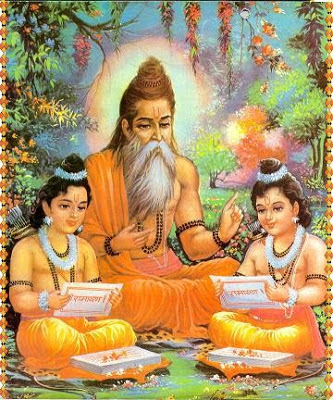
Below I present a fragment of the book "Raja Yoga" by Swami Vivekananda; in which the story of the deva and the devil is told, along with a small explanation of the wise Yogi. Vivekananda was one of the pioneers of Yoga in the West, and one of the highest authorities in Raja Yoga.

Fable yoga deva demon
“... The legend refers that once a deva and a demon came to a sage so that theyteach what the nature of Being was.Both studied long time with the wise, who finally told them:-You are the Being that you are looking for.The deva and the devil believed that their bodies were the true Self to which the wisereferred, and both returned to their respective spheres, very satisfied, and toldhis companions:

- We learned everything we had to learn.Let's eat, drink andlet's slack offWe are the Self and nothing is beyond ourselves. The devil was by nature ignorant, dark-minded, and without further investigation. He remained satisfied with the idea that the body was his true being.But the nature of the deva was pure, and although at first he made the mistake ofidentify with your body and surrender to every lineage of enjoyment, soon guessingthat his wise instructor had not referred to the body, telling them that they themselves werethe Being they were looking for, but it must be something superior.

Consequently, he turned again to the wise and said:

- Mr, You taught me that this my body was the true Self;but I see that all bodies die, and the Being cannot die.

The wise replied:- Know yourself. You are that.
The deva returned to its sphere believed that the mind was the Being; but he soon observed that thoughts were variable, sometimes good, sometimes bad, and that the mind was too volatile and inconstant for the Being to be.

The deva resorted again to the wise and said:- Mr, I don't think the mind is the Being. You told me it is.

The wise replied:- I didn't tell you such. Know yourself. You are that.

The deva returned to its sphere and finally recognized that it was the Being beyond the body and the mind. Thus did the deva know that the spirit, the true Self is eternal, without birth or death,that neither sword hurts him nor water wets him nor fire burns him nor air he ores him;which is infinite,omniscient, intangible, omnipotent and transcends body and mind.In this way he was satisfied, while the poor demon did not get to know the true for his blind love of the body.”

In this world there are many whose nature is similar to that of the demon of the legend, but there are also some of the nature of deva.

If someone teaches how to increase the possibility of bodily enjoyment, they will attendmany to listen to him, but if he intends to show the path that leads to the goal supreme, will have few listeners.

Few are able to understand spiritual things and less still those who they have patience to reach them; but there are some who know that even if the body lived a thousand years the end result would be the same.

The physical body changes slowly and incessantly and no one is able to prevent even by a moment this alteration of your body, that without remedy has to disintegrate when cease the forces that maintain it.

The text says:

"As the waters of a river ceaselessly move, so the body moves."However, the body must be kept healthy and robust, because it is the best instrument we have..."


Fragment of the book "Raja Yoga", by Swami Vivekananda

Gopal

HATHA RAJA YOGA

The origin and meaning of Yoga is lost in the night of time, and thousands of lines, teachers and interpretations have appeared over the centuries. I don't know what the origin of Yoga is, nor what exactly the word hatha means , I don't even know what the style or line of Yoga that I follow is for sure. Yes I know that my style is within the raja and hatha Yoga, but better to call it Yoga (dry), so as not to get lost in the names, nor in the interpretations that could derive from them.

What is known for certain, leaving aside all other mystical or superstitious interpretation, is that the first great teacher, and synthesizer of Yoga, was Patanjali , a sage who lived in India in the third century before Christ, approximately; and his masterpiece is the Yoga Sutras , a four-volume compendium where Yoga Science is explained in brief and synthetic phrases (sutras). It has Vedic origins, and is one of the six systems of thought ( dharsanas ) of Hinduism; and its greatest sources of influence are the Bhagavad Guita and some Upanishads .

Patanjali synthesized Yoga in eight steps, so it is known as Asthanga (eight feet) Yoga, or Raja Yoga (Royal Yoga, or kings).

  1. Yama (observances towards others)
  2. Niyama (self-observance)
  3. Asana (Physical posture or physical exercise)
  4. Pranayama (Control of breathing or energy)
  5. Pratiahara (Control of the senses)
  6. Dharana (Concentration)
  7. Dhyana (Meditation)
  8. Samadhi (Realization)
The Yoga Sutras of Patanjali are one of the highest works of humanity in terms of knowledge and study of the human psyche; His study is highly recommended along with the Bhagavad-Guita . In this blog we will be posting posts on such matters.

Hatha Raja Yoga
One important thing is to say: Patanjali does not give any instruction on physical or breathing exercises, apart from a few simple and simple recommendations. 

Yoga known today with its characteristic physical exercises does not appear until the fourteenth century, when Swatmarama publishes Hatha Yoga Pradipika (Light on Hatha Yoga), which is the first and most important work written on Hatha Yoga . 

If before Swatmarama the techniques of hatha yoga were practiced, I ignore it, to written sources I refer. Some say that Yoga is twelve thousand years old (in full stone age); and who says that in Mohenjo Daro and Harappa asanas were made in 4000 BC I don't know. Yoga Sutras III century BC; Hatha Yoga Pradipika 14th century AD, this is what is documented ...

Hatha has many meanings: etymologically means to force, violate or persevere. Some say that Ha means Sun, and Tha Luna; and that the goal of hatha yoga is to balance the energy of the body, the polarity of going and pingala to achieve balance; but etymologically has no resemblance, so it seems an addition to convenience a posteriori. 

Honestly, I have no idea what its meaning will be. Hatha Yoga has Tantric-Shivaitic influences, and differs in part from the Vedic vision of Patanjali . The key is to integrate them well.

Anyway , from Swatmarama and Gheranda (another later teacher) come the majority of techniques that we know today, especially in regard to asanas and pranayama , and subsequently there have been additions such as "Greeting to the Sun", and other series of specific exercises.

In the twentieth century, a great Yoga teacher appeared in the West, giving Raja and Hatha Yoga a wide diffusion, with a peculiar touch; it was Swami Vishnudevananda , disciple of Swami Sivananda . A mixture of Raja Hatha Yoga with a strong Vedic and Hindu accent, but with a fabulous concept of five principles:

  • Adequate food. 
  • Adequate breathing .     
  • Proper exercise. 
  • Adequate rest. 
  • Positive thinking and meditation (cultivation of the mind).
Thus, in the 21st century, with these five principles everything else can be synthesized, adapting the practice to the needs of each person; no dogmatisms, no superstitions, no rigid lines, no mortifications or austerities, using the best of all the techniques we know, using common sense and intelligence. We are in the third millennium, where Western science has to merge with Eastern wisdom, but intelligently, without fanaticism; adapting, or adapting (to do justice to the five principles) to time and place; with an open mind and heart. It does not matter where it comes from and what were the initial motivations of the foundation of Yoga. The important thing is what we do with it in this time that we have had to live, and how we apply it to our lives.

What kind of Yoga do you do? For Yoga to dry; Yoga of union, Yoga of synthesis; Eclectic Yoga (which assimilates the best of each system); Smart Yoga Learn to breathe well, keep the body in conditions through moderate exercise, learn to relax and release tension, and cultivate the mind through study, meditation and positive thinking.

For what? To lead a richer and fuller life, and little by little to know who we are, where we come from and where we are going, reaching the Realization of Being, the greatest enterprise that human beings can achieve.


But all this done with freedom, without fear, without dogmas, without closed structures, without religious institutions, without Gurus, without hypocrites who tell us what we have to do and how we have to do it, without borders, without limits ... The present is ours; we walk the way. We are the rulers and judges of our life.

Gopal

What is Yoga for?

Yoga serves, above all, to be yourself.

Yoga serves to know how our body works, our emotions and our mind; and following this knowledge, to acquire power over them.
What is yoga for?
Yoga serves to give meaning to our lives, making once we have found this meaning, everything we do really makes sense.

Yoga serves to harmonize and balance our body, detaching itself from its practice: Health and Beauty .

Yoga serves to harmonize and balance our emotions, detaching from its practice: Peace and Goodness .

Yoga serves to harmonize and balance our mind, detaching itself from its practice: Truth .

Yoga serves, to raise self-esteem and self-esteem, and therefore, to foster relationships with our fellow man.

Yoga serves, to sow in the Present the good seeds that in the future allow us to reap Material and Spiritual Proseprity .

Yoga serves to find the way back home; that which is inside our hearts.
Yoga serves, in short, to achieve a fuller and happier life; radiating that positive vibration towards everything around us.

Yoga serves, to realize the greatest enterprise that the Human Being can perform: BE REALLY HUMAN .

Gopal

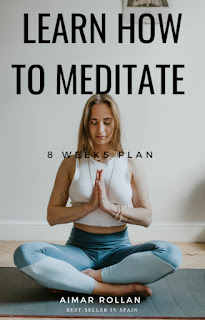
LEARN HOW TO MEDITATE

My book LEARN HOW TO MEDITATE (8 weeks plan), available in English.

In kindle only for 0,99 $.

Aimar Rollan's book about meditation

In this short book you will learn to meditate from scratch, in your own home, sitting in a chair.

We will learn the basic theory and some simple but deep meditation techniques, based on mindfulness, yoga and Zen.

We will consolidate the habit through an 8-week program, specially designed to encourage in us the habit of meditating every day in a corner of our house.

Prior knowledge is not necessary, nor can you sit cross-legged, or be religious or a lover of oriental traditions. Meditation is a universal technique that will help us control our mind, reduce stress and get to know ourselves better.We will start by meditating one minute a day and at the end of the 8 weeks we will be able to meditate 20 minutes in a row. The idea is that meditation will be a part of our daily routine so that it can help us lead a fuller and happier life.

What will you learn with this book?

- What is meditation?

- History of meditation.

- Differences between meditation and mindfulness.

- The importance of habit and routine.

- How the mind works.

- How to sit correctly in a chair to meditate.

- The abdominal breathing technique.

- Basic meditation techniques.

- What feelings can we have during meditation.

- How to progress properly.

"All the misfortunes of man derive from the fact that he is not able to sit quietly, alone, in a room." Blaise Pascal


Best-seller in Spain in its category.


Aimar Rollan (Gopal)


Cycling as a complement to yoga at home

Cycling is the ideal complement for yoga at home, as it allows us to do aerobic work and train our cardiovascular system.

We have already said on several occasions that while yoga is an excellent physical exercise, it may have certain deficiencies in cardiovascular training. For this reason, an exercise bike is an excellent investment if we want to get in shape without leaving home.
Cycling and yoga
We understand as cardiovascular work all that exercise that keeps our heart beating at 60% - 70% of its maximum frequency (HRmax), for a duration of between 20 and 60 minutes.
Aerobic cardiovascular work serves to:

  • Strengthen the heart
  • Capillarize the muscles and get more blood and oxygen throughout the body.
  • Increase metabolism and burn fat.
  • Release of endorphins (wellness hormones).

Surely there are many more benefits, but only with the aforementioned, it is more than enough reason to do a little cardio.

How do we train?

One of the biggest obstacles to exercise is laziness , so if we have the bicycle "at hand", in some room of our house, we just have to get on it and start pedaling. We can do 2 or 3 weekly sessions of a minimum duration of 20 minutes ( ideally 40 minutes ).

To be more enjoyable and productive, we can pedal while listening to a podcast or if we have the bike in front of a television, watch a documentary. In this way, in addition to exercising the body, we also cultivate a bit . Of course you can also listen to music if that encourages and motivates you more.

An advantage is that most modern exercise bikes have heart rate monitors installed in the handlebar , in the form of metal plates, which only by putting our two hands on top allows us to know our pulsations per minute This is very useful to keep the cadence and rhythm inside of an aerobic frequency.

Pulse

The first thing we have to know is our FCmax ( maximum heart rate ). A simple formula to calculate it is as follows:

FCmax = 220 - age

There are more complex formulas that take weight and fitness into account, but as a reference, with the above formula we can obtain a fairly accurate estimate.

For example, a 35-year-old person will have an HRmax of 185 beats per minute.

60% for her will be 111 ppm and 70% will be 130 ppm. Knowing this, we can do bicycle routines in which our heart stays between approximately 110 and 130 ppm.

It is important that everyone calculate their FCmax and their FC60% and FC70%, so that they know what the intensity of their exercise should be.

That is the ideal range for aerobic exercise, and contrary to what you think, more intensity is not synonymous with more effective work. The duration of the exercise is also important, less than 20 minutes will hardly have an impact on the body.

If you are in a very low form, do not be surprised that your pulsations are triggered before the minimum effort, in that case you will have to pedal very softly until your heart is gradually trained.

Before or after a yoga session?

Ideally, do it before, and then yoga will help you stretch and relax, although you can do isolated cardio sessions.


From here I encourage you and I recommend that you add this plus to your life, and do not consider the purchase of an exercise cycling as an expense, but as an investment in your health.

Gopal

What is spirituality?

What does spirituality mean? Do you consider yourself spiritual? Let's try to clarify this concept.
Spirituality derives from "spirit." The spirit is something immaterial that cannot be perceived through the physical senses. The spirit is "the principle of life" that dwells in the deepest part of ourselves, our purest essence. A spiritual person is one in whom these immaterial and transcendental concepts have a certain weight in their life, and to some extent, they govern the course of their steps.
What is spirituality?
The counterpoint of spirituality is materialism , in the sense that there is only and is valid what can be perceived with the physical senses . Modern Science is the champion of materialism, and today, many people are materialistic because Science has an extraordinary weight and authority in our society. It is not necessary to fall into the error of considering the materialist in the popular context of "a person with a closed mind and attached to material objects", that is a very vain definition. Materialism is very good, as this allows us to discover and dominate the material world.
For centuries, the word "spirituality" was not used as such, since almost everyone was religious, and this should be clarified: religiosity is not the same as spirituality . Religiosity implies a belief in the postulates and dogmas of the religion that one follows. Spirituality entails an inner experience about oneself.

You can be religious and spiritual, but you can also be spiritual without being religious.

  • Being spiritual does not imply believing in gods, dogmas or doctrines.
  • Being spiritual does not imply practicing yoga, meditation, reiki or any other New Age stream.
  • Being spiritual does not imply being vegetarian, nor pacifist, nor being in favor of animal rights.
  • Being spiritual does not imply being dressed in white, speaking slowly and greeting with your palms together saying " namaste ."
Being spiritual means that we spend a few minutes a day to look inward and disconnect from matter to reach communion with ourselves . Little by little, as we look inwards, we reach an intuitive conclusion that we are more than matter, that there is something else ... An underlying, silent, eternal spirit that reigns in the sancta sanctorum of the deepest of ourselves.
Then we open our eyes and return to being chained to matter and subject to its laws , but if anything, we act in a subtly different way, since we recognize that we are spiritual beings in essence, who have had to live this experience called « life human ». This experience makes us more ethical and moral (in most cases), but not because of following certain rules or because of fear of reprisals, but because such dictates arise from our hearts before the understanding that others and the world are a prolongation from ourselves.
Spirituality is everyone's business, and it doesn't have to be noticed , at least externally. If it shows a lot, if we draw attention with extravagant outfits and gestures ..., we may not be as spiritual as we believe.
Symbolically, the spirit is related to the circumference or the sphere (the most perfect geometric figures). Matter is symbolized by the number 4, the square or the cross . Man is a crucified spirit in matter, that is his symbol.
SĆ­mbolo del hombre

The spiritual being, the initiate, is the one who tries to free himself from his chains . However, this process is long and arduous, and we must know how to reconcile the spiritual with the material. We have to value, enjoy and enjoy everything material; we have to be happy in this physical plane and, as far as possible, improve this world, making it more beautiful, good and fair. All this, of course, without forgetting to spend a few minutes a day, just a few minutes, to look inside.

Gopal

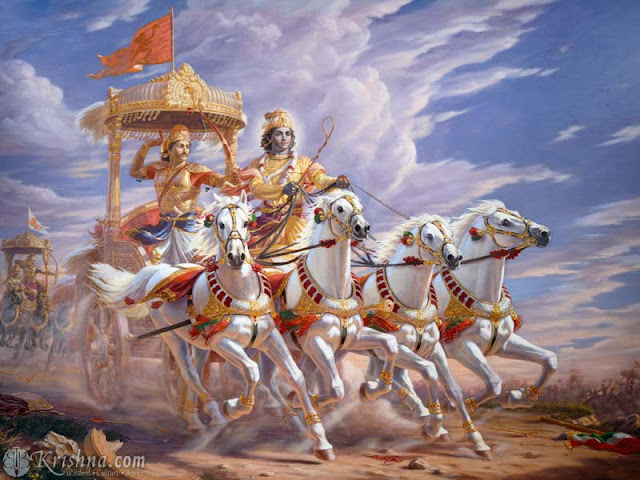
Bhagavad Gita

The Bhagavad Gita is undoubtedly one of the most inspired texts that humanity possesses. In Hinduism it is considered a sacred text, and it is also the first written text that deals with yoga.


The entire text (700 verses) is a dialogue between the teacher (Krishna) and his disciple (Arjuna), where he instructs him in yoga just before starting a battle between the PĆ”ndavas and the Kauravas. Bhagavad Gita means " the song ( gita ) of Krishna ( Bhagavan ) ", although because bhagavan is a venerable title meaning "Lord," it is often translated as "The song of the Lord," or "The song of God". Also, due to its importance as a yoga text, it is known as Yoga upanishad .
Bhagavad Gita
This book (dating from the first millennium BC) is a kind of "Bible" for Hindus, but for us, yoga students, it is a compendium of wisdom, and what interests us is " the teaching " that the teacher gives his disciple, rather than the context on which the story is situated.

For Hinduists, Krishna is an avatar of the god Visnhu (the Conservative). The text is part of the great epic called Mahabarata , and has the quality of sruti (revealed text) and smriti (remembered text). Its authorship is unknown, although the wise Viasa is the author of the Mahabarata .

As in any religious text, there are numerous versions and translations , some of them faithful to the original in Sanskrit, others manipulated or stained according to the ideology of the one who translated it. There are illegible versions (due to its literality with the Sanskrit language) and very poetic versions (adapted to the Castilian language in this case). There are versions that are limited to reproducing the original text, and others full of comments between paragraph and paragraph by the translator, a fact that cuts the narrative and can create confusing ideas.

For me, the best version I know is that of 1896 by J. Roviralta Borrell , a Spanish theosophist. Srila Prabhupada's version is very good also if we read only the rough and faithful translation to the original text; The rest of the book are his comments, very tinged with his Hare Krishna ideology. There are dozens of versions, I don't know all of them.
Well, like any sacred text, it can have two interpretations: literal or symbolic . That is, we can believe that the story really happened and that Krishna was an incarnation of God, or interpret the text symbolically, assigning each character and situation in the story as a part of ourselves, as a universal archetype :

  • Krishna : inner teacher (spirit).
  • Arjuna : mature psyche (soul).
  • Blind King Diritarastra and his son Dur and odhana ("how hard to gnaw"): personality.
  • Sanjaya ( court seer): the storyteller, who has the ability to see beyond the material (intuition).
  • Army of the PĆ”ndavas : The luminous forces that elevate us towards spirituality.
  • Army of the Kauravas : The dark forces that drag us towards matter.
  • Kurukshetra (plain where the battle takes place): Our body (the stage where everything happens to us).
Krishna and Arjuna
Because it would be very long to explain the whole context of the story and unravel it completely, I have decided to make several videos where I will read the story and, from my understanding, I will add comments to clarify certain concepts. I will make a video per chapter (18 in total), and I hope this work can help those interested in this topic, as well as yoga teachers who want to delve into the origins of this discipline.


I are uploading the videos on my Youtube channel, and I will also upload them to Ivoox in Mp3 format.

Gopal

BUDDHA: Life and teachings

Siddhartha Gautama, called the Buddha, has undoubtedly been one of the most influential personalities in the history of mankind. In this article we will make a brief summary of his life and his teaching.

Siddhartha was born in the city of Kapilavastu, in northern India, in the 6th century BC , in the full moon of May, in the bosom of the nobility. His mother, Queen Maya, died a few days after giving birth. There were several prophecies during his birth, one of them was that he would be a great king or a great renunciate , for this reason, his father, King Sudodana protected him from all religious teaching and kept him from suffering.
Siddhartha Gautama
He married Yasodhara and had a son named Rajula, and at 29 years of age his life changed when he met for the first time in his life with an old man, a sick man, a corpse and an ascetic. From that moment he decided that he would overcome suffering and death, so he abandoned his family and his palace to become a renunciate .

For the next six years he wandered through India learning from different yoga teachers all kinds of techniques to achieve liberation. He underwent hard asceticism, fasting and long meditation sessions, until at age 35 he almost died drowned when bathing in a river, due to his weakness caused by mortifications and fasting. Then he understood: the secret was in balance, in the middle ... Not too many mortifications, not too much hedonism. Moderation, balance, not falling into excesses of any kind. For this reason he called his way, "the middle way.

"Shortly after he reached Nirvana, the supreme state, after a 49-day meditation in a row under a fig tree. From there, Siddhartha Gautama was known as "the Buddha," which means "the awake."
Buda meditating
For the next 45 years he devoted himself to teaching his doctrine in northwestern India, until he died at 80 years of age. Later his disciples spread his teaching throughout Asia in what is now known as Buddhism. That was more than 2500 years ago ...
His teaching is based on the 4 noble truths :
  1. There is suffering.
  2. The origin of suffering is desire.
  3. It is possible to free yourself from suffering.
  4. The noble eightfold path is the path that leads to liberation.
The noble eightfold path consists of the following points:
  1. Correct understanding.
  2. Right thinking.
  3. Right word.
  4. Correct action.
  5. Right livelihoods.
  6. Right effort.
  7. Correct attention.
  8. Correct concentration.
In short : His teaching is based on moderation , ethics and compassion , and especially on meditation.

To follow the path of Buddha, from my point of view, it is not necessary to become a Buddhist or dress with any habit, it is enough to be moderate, compassionate and acquire the habit of meditating.
I have further developed the topic in the following video:


I highly recommend the following readings:

- Buddha, his life and teachings . Osho
- Siddhartha . Hermann Hesse

To set this article, some music with Tibetan incantations .


Gopal

The Kaizen method


The Kaizen method is a Japanese technique of continuous improvement, applicable to all areas of life: business, business, health, sport, yoga ...

Lao Tzu This method, or philosophy , began mostly to be heard at the business level, to improve production. Famous are their " 5S " to achieve better orderly and effective work environments:
  • Seiri (classification)
  • Seiton (order)
  • Seiso (cleaning)
  • Seiketsu (standardization)
  • Shitsuke (discipline)
But apart from this, and leaving aside the business field, the most important thing is its associated philosophy, in which it is especially important to achieve great results by taking small steps .
It is very difficult for something to prosper if we have to make great initial efforts, because we have high chances of giving up before the habit of doing so is generated in us. For this reason, the Kaizen method proposes to start with short and simple activities, and through continuous improvement , increase them and eventually achieve great benefits.

Under this philosophy my yoga course for beginners is created, with the aim of doing very short and simple routines to create the habit , and then gradually increase the time and difficulty of the exercises. Thus, we start the day with a routine of 3 to 5 minutes, simpler impossible to perform. In the afternoon we do the star exercise, the Greeting to the Sun, 2 times the first sessions and then we increase the number progressively, to end in another simple nighttime routine.
The next course I will do, to teach meditation, will be covered under the same philosophy, that of the Kaizen method, since I have proven that it works . And I insist, this is applicable to everything you intend to do , be it a diet, a sport, learn a language, improve the production of your company or be a better person, always under the following maxims :
"Don't let a day go by without improving yourself"
"Today better than yesterday, tomorrow better than today!"
"A step in the right direction every day is better than no step"
"Commitment and discipline"
"Plan, do, verify and act"

"A series of continuous and small improvements is better than a single large change"
"The effectiveness of simplicity and minimalism"