Showing posts with label history. Show all posts

Niyama: the great unknown

Yoga has eight steps in its realization scale. In a previous post we talked about the first, about Yama , natural morality. Today we will talk about the second, the Niyama .


Most people know Yoga by its third step, the Asanas , or body exercises, by its room, Pranayama , breathing techniques; or at most for his seventh, Dhyana , or meditation. But as indicated in the title, Niyama is the great unknown, despite its great importance.


If the Yama are the observances towards others, the Niyama are the observances towards oneself. And from the point of view of Patanjali Maharishi, and from mine as well, one should not move on to the third step of Yoga without first practicing and integrating Niyama.

Although as things stand today, and with the superficiality that reigns on the planet, I would stay alone in Yoga class if I were so strict; since the vast majority of people are looking for a sport to stretch their backs.
Niyama

Niyama points:


1.Soucha: Cleaning and purification of the physical body. Here comes personal hygiene, which many have neglected, and deep purification of the physical body, such as cleaning the nose, tongue, stomach and intestines. Yoga has techniques ( kriyas ) for such needs, and its practice contributes significantly to improve health, by eliminating both "external" dirt and internal. We will go deeper into another post on such issues.


2.Santosha: Contentment. This word is of the utmost importance to find happiness in this life. Contentment does not mean resignation, or conformism, it means being content with what one is and possesses in each moment, in this life. What happens to us at a given time is the best that could happen to our personal evolution at a given time; and what we have is what we need.So contentment brings us equanimity, peace and happiness. In the end it is a matter of intelligence: love what you do, love what you have, love the people with whom you share your life, love what happens to you in every moment. With this mental attitude, what can cloud our happiness?


3.Tapas: Means asceticism, austerity, or self-discipline. You don't have to be an ascetic, or make votes of any kind. It simply means that a practice must be sought and followed with discipline every day; that is part of the daily routine, such as eating, drinking or sleeping. Starting something is easy, be it an activity or a relationship. The really difficult thing is to keep it in time, to have enough perseverance to deepen it, without giving in to the first difficulties. In the end, constant practice makes one a teacher, whatever the discipline; but in this case, by faithfully following the practices of Yoga, one becomes a Master with capital letters, in the art of Life.


4.Swadhyaya: Spiritual or metaphysical study. Knowledge is power, and if we do not know our object of study, practices lack direction and depth. What is our object of study? We ourselves, the Being, the Atman, the ultimate meaning of existence. "Oh man, know yourself!" It was the inscription of the frontispiece of the sanctuary of Delphi. This has always been the maxim of Gnosis, of the knowledge of the Self. He who does not devote time to the study of such questions, is ignorant, and I do not say it in a derogatory tone, but with the meaning that ignorant is one who ignores something, and if in this case it is a relative knowledge of himself, his ignorance is even more devious.


5. Iswara Pranidhana : Surrender to the absolute, devotion to God. This is perhaps the most conflictive point, especially today in our western culture. It consists in rendering our actions to the divine that dwells in us, in having faith and devotion in God, or that principle that underlies all things, orders them and gives them meaning. In any case it is not a blind faith, but a certainty that arises with practice. A certainty that there is something beyond the finite matter, something that transcends, sustains and orders it. We are not alone in our journey, and although we are not aware of it, sooner or later, Iswara Pranidhana awakens in every sincere seeker.


These are the five principles of Niyama .
(A bit of irony)
- Do you practice Yoga?
- Yes, the practical in the sports center for three months; Look how I bend and how I make the pine. I think in three more months of practice I have already mastered it.
- Me too, I have been practicing it for a year, I think I will soon take a course to be a teacher.
- The other day I read a post about Niyama.
- Niyama? What is that?


Aimar Rollan (Gopal)

Fable of Deva and Demon

Below I present a fragment of the book "Raja Yoga" by Swami Vivekananda; in which the story of the deva and the devil is told, along with a small explanation of the wise Yogi. Vivekananda was one of the pioneers of Yoga in the West, and one of the highest authorities in Raja Yoga.

Fable yoga deva demon
“... The legend refers that once a deva and a demon came to a sage so that theyteach what the nature of Being was.Both studied long time with the wise, who finally told them:-You are the Being that you are looking for.The deva and the devil believed that their bodies were the true Self to which the wisereferred, and both returned to their respective spheres, very satisfied, and toldhis companions:

- We learned everything we had to learn.Let's eat, drink andlet's slack offWe are the Self and nothing is beyond ourselves. The devil was by nature ignorant, dark-minded, and without further investigation. He remained satisfied with the idea that the body was his true being.But the nature of the deva was pure, and although at first he made the mistake ofidentify with your body and surrender to every lineage of enjoyment, soon guessingthat his wise instructor had not referred to the body, telling them that they themselves werethe Being they were looking for, but it must be something superior.

Consequently, he turned again to the wise and said:

- Mr, You taught me that this my body was the true Self;but I see that all bodies die, and the Being cannot die.

The wise replied:- Know yourself. You are that.
The deva returned to its sphere believed that the mind was the Being; but he soon observed that thoughts were variable, sometimes good, sometimes bad, and that the mind was too volatile and inconstant for the Being to be.

The deva resorted again to the wise and said:- Mr, I don't think the mind is the Being. You told me it is.

The wise replied:- I didn't tell you such. Know yourself. You are that.

The deva returned to its sphere and finally recognized that it was the Being beyond the body and the mind. Thus did the deva know that the spirit, the true Self is eternal, without birth or death,that neither sword hurts him nor water wets him nor fire burns him nor air he ores him;which is infinite,omniscient, intangible, omnipotent and transcends body and mind.In this way he was satisfied, while the poor demon did not get to know the true for his blind love of the body.”

In this world there are many whose nature is similar to that of the demon of the legend, but there are also some of the nature of deva.

If someone teaches how to increase the possibility of bodily enjoyment, they will attendmany to listen to him, but if he intends to show the path that leads to the goal supreme, will have few listeners.

Few are able to understand spiritual things and less still those who they have patience to reach them; but there are some who know that even if the body lived a thousand years the end result would be the same.

The physical body changes slowly and incessantly and no one is able to prevent even by a moment this alteration of your body, that without remedy has to disintegrate when cease the forces that maintain it.

The text says:

"As the waters of a river ceaselessly move, so the body moves."However, the body must be kept healthy and robust, because it is the best instrument we have..."


Fragment of the book "Raja Yoga", by Swami Vivekananda

Gopal

HATHA RAJA YOGA

The origin and meaning of Yoga is lost in the night of time, and thousands of lines, teachers and interpretations have appeared over the centuries. I don't know what the origin of Yoga is, nor what exactly the word hatha means , I don't even know what the style or line of Yoga that I follow is for sure. Yes I know that my style is within the raja and hatha Yoga, but better to call it Yoga (dry), so as not to get lost in the names, nor in the interpretations that could derive from them.

What is known for certain, leaving aside all other mystical or superstitious interpretation, is that the first great teacher, and synthesizer of Yoga, was Patanjali , a sage who lived in India in the third century before Christ, approximately; and his masterpiece is the Yoga Sutras , a four-volume compendium where Yoga Science is explained in brief and synthetic phrases (sutras). It has Vedic origins, and is one of the six systems of thought ( dharsanas ) of Hinduism; and its greatest sources of influence are the Bhagavad Guita and some Upanishads .

Patanjali synthesized Yoga in eight steps, so it is known as Asthanga (eight feet) Yoga, or Raja Yoga (Royal Yoga, or kings).

  1. Yama (observances towards others)
  2. Niyama (self-observance)
  3. Asana (Physical posture or physical exercise)
  4. Pranayama (Control of breathing or energy)
  5. Pratiahara (Control of the senses)
  6. Dharana (Concentration)
  7. Dhyana (Meditation)
  8. Samadhi (Realization)
The Yoga Sutras of Patanjali are one of the highest works of humanity in terms of knowledge and study of the human psyche; His study is highly recommended along with the Bhagavad-Guita . In this blog we will be posting posts on such matters.

Hatha Raja Yoga
One important thing is to say: Patanjali does not give any instruction on physical or breathing exercises, apart from a few simple and simple recommendations. 

Yoga known today with its characteristic physical exercises does not appear until the fourteenth century, when Swatmarama publishes Hatha Yoga Pradipika (Light on Hatha Yoga), which is the first and most important work written on Hatha Yoga . 

If before Swatmarama the techniques of hatha yoga were practiced, I ignore it, to written sources I refer. Some say that Yoga is twelve thousand years old (in full stone age); and who says that in Mohenjo Daro and Harappa asanas were made in 4000 BC I don't know. Yoga Sutras III century BC; Hatha Yoga Pradipika 14th century AD, this is what is documented ...

Hatha has many meanings: etymologically means to force, violate or persevere. Some say that Ha means Sun, and Tha Luna; and that the goal of hatha yoga is to balance the energy of the body, the polarity of going and pingala to achieve balance; but etymologically has no resemblance, so it seems an addition to convenience a posteriori. 

Honestly, I have no idea what its meaning will be. Hatha Yoga has Tantric-Shivaitic influences, and differs in part from the Vedic vision of Patanjali . The key is to integrate them well.

Anyway , from Swatmarama and Gheranda (another later teacher) come the majority of techniques that we know today, especially in regard to asanas and pranayama , and subsequently there have been additions such as "Greeting to the Sun", and other series of specific exercises.

In the twentieth century, a great Yoga teacher appeared in the West, giving Raja and Hatha Yoga a wide diffusion, with a peculiar touch; it was Swami Vishnudevananda , disciple of Swami Sivananda . A mixture of Raja Hatha Yoga with a strong Vedic and Hindu accent, but with a fabulous concept of five principles:

  • Adequate food. 
  • Adequate breathing .     
  • Proper exercise. 
  • Adequate rest. 
  • Positive thinking and meditation (cultivation of the mind).
Thus, in the 21st century, with these five principles everything else can be synthesized, adapting the practice to the needs of each person; no dogmatisms, no superstitions, no rigid lines, no mortifications or austerities, using the best of all the techniques we know, using common sense and intelligence. We are in the third millennium, where Western science has to merge with Eastern wisdom, but intelligently, without fanaticism; adapting, or adapting (to do justice to the five principles) to time and place; with an open mind and heart. It does not matter where it comes from and what were the initial motivations of the foundation of Yoga. The important thing is what we do with it in this time that we have had to live, and how we apply it to our lives.

What kind of Yoga do you do? For Yoga to dry; Yoga of union, Yoga of synthesis; Eclectic Yoga (which assimilates the best of each system); Smart Yoga Learn to breathe well, keep the body in conditions through moderate exercise, learn to relax and release tension, and cultivate the mind through study, meditation and positive thinking.

For what? To lead a richer and fuller life, and little by little to know who we are, where we come from and where we are going, reaching the Realization of Being, the greatest enterprise that human beings can achieve.


But all this done with freedom, without fear, without dogmas, without closed structures, without religious institutions, without Gurus, without hypocrites who tell us what we have to do and how we have to do it, without borders, without limits ... The present is ours; we walk the way. We are the rulers and judges of our life.

Gopal

Bhagavad Gita

The Bhagavad Gita is undoubtedly one of the most inspired texts that humanity possesses. In Hinduism it is considered a sacred text, and it is also the first written text that deals with yoga.


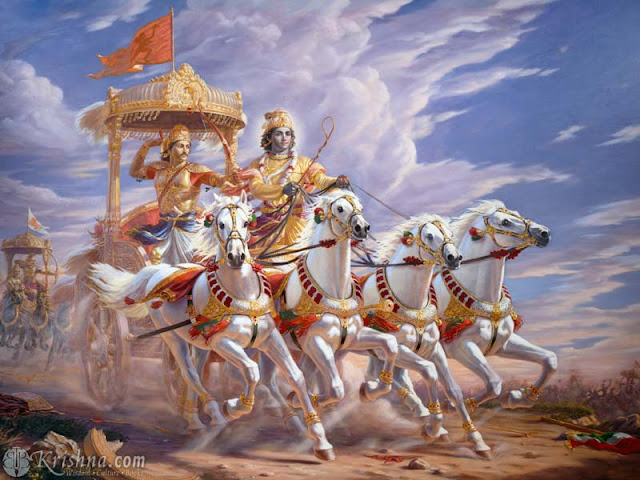
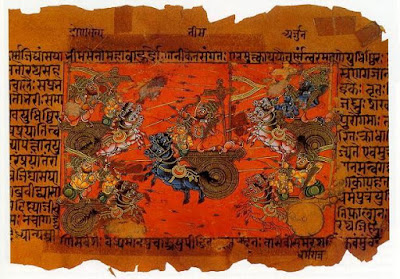
The entire text (700 verses) is a dialogue between the teacher (Krishna) and his disciple (Arjuna), where he instructs him in yoga just before starting a battle between the Pándavas and the Kauravas. Bhagavad Gita means " the song ( gita ) of Krishna ( Bhagavan ) ", although because bhagavan is a venerable title meaning "Lord," it is often translated as "The song of the Lord," or "The song of God". Also, due to its importance as a yoga text, it is known as Yoga upanishad .
Bhagavad Gita
This book (dating from the first millennium BC) is a kind of "Bible" for Hindus, but for us, yoga students, it is a compendium of wisdom, and what interests us is " the teaching " that the teacher gives his disciple, rather than the context on which the story is situated.

For Hinduists, Krishna is an avatar of the god Visnhu (the Conservative). The text is part of the great epic called Mahabarata , and has the quality of sruti (revealed text) and smriti (remembered text). Its authorship is unknown, although the wise Viasa is the author of the Mahabarata .

As in any religious text, there are numerous versions and translations , some of them faithful to the original in Sanskrit, others manipulated or stained according to the ideology of the one who translated it. There are illegible versions (due to its literality with the Sanskrit language) and very poetic versions (adapted to the Castilian language in this case). There are versions that are limited to reproducing the original text, and others full of comments between paragraph and paragraph by the translator, a fact that cuts the narrative and can create confusing ideas.

For me, the best version I know is that of 1896 by J. Roviralta Borrell , a Spanish theosophist. Srila Prabhupada's version is very good also if we read only the rough and faithful translation to the original text; The rest of the book are his comments, very tinged with his Hare Krishna ideology. There are dozens of versions, I don't know all of them.
Well, like any sacred text, it can have two interpretations: literal or symbolic . That is, we can believe that the story really happened and that Krishna was an incarnation of God, or interpret the text symbolically, assigning each character and situation in the story as a part of ourselves, as a universal archetype :

  • Krishna : inner teacher (spirit).
  • Arjuna : mature psyche (soul).
  • Blind King Diritarastra and his son Dur and odhana ("how hard to gnaw"): personality.
  • Sanjaya ( court seer): the storyteller, who has the ability to see beyond the material (intuition).
  • Army of the Pándavas : The luminous forces that elevate us towards spirituality.
  • Army of the Kauravas : The dark forces that drag us towards matter.
  • Kurukshetra (plain where the battle takes place): Our body (the stage where everything happens to us).
Krishna and Arjuna
Because it would be very long to explain the whole context of the story and unravel it completely, I have decided to make several videos where I will read the story and, from my understanding, I will add comments to clarify certain concepts. I will make a video per chapter (18 in total), and I hope this work can help those interested in this topic, as well as yoga teachers who want to delve into the origins of this discipline.


I are uploading the videos on my Youtube channel, and I will also upload them to Ivoox in Mp3 format.

Gopal

BUDDHA: Life and teachings

Siddhartha Gautama, called the Buddha, has undoubtedly been one of the most influential personalities in the history of mankind. In this article we will make a brief summary of his life and his teaching.

Siddhartha was born in the city of Kapilavastu, in northern India, in the 6th century BC , in the full moon of May, in the bosom of the nobility. His mother, Queen Maya, died a few days after giving birth. There were several prophecies during his birth, one of them was that he would be a great king or a great renunciate , for this reason, his father, King Sudodana protected him from all religious teaching and kept him from suffering.
Siddhartha Gautama
He married Yasodhara and had a son named Rajula, and at 29 years of age his life changed when he met for the first time in his life with an old man, a sick man, a corpse and an ascetic. From that moment he decided that he would overcome suffering and death, so he abandoned his family and his palace to become a renunciate .

For the next six years he wandered through India learning from different yoga teachers all kinds of techniques to achieve liberation. He underwent hard asceticism, fasting and long meditation sessions, until at age 35 he almost died drowned when bathing in a river, due to his weakness caused by mortifications and fasting. Then he understood: the secret was in balance, in the middle ... Not too many mortifications, not too much hedonism. Moderation, balance, not falling into excesses of any kind. For this reason he called his way, "the middle way.

"Shortly after he reached Nirvana, the supreme state, after a 49-day meditation in a row under a fig tree. From there, Siddhartha Gautama was known as "the Buddha," which means "the awake."
Buda meditating
For the next 45 years he devoted himself to teaching his doctrine in northwestern India, until he died at 80 years of age. Later his disciples spread his teaching throughout Asia in what is now known as Buddhism. That was more than 2500 years ago ...
His teaching is based on the 4 noble truths :
  1. There is suffering.
  2. The origin of suffering is desire.
  3. It is possible to free yourself from suffering.
  4. The noble eightfold path is the path that leads to liberation.
The noble eightfold path consists of the following points:
  1. Correct understanding.
  2. Right thinking.
  3. Right word.
  4. Correct action.
  5. Right livelihoods.
  6. Right effort.
  7. Correct attention.
  8. Correct concentration.
In short : His teaching is based on moderation , ethics and compassion , and especially on meditation.

To follow the path of Buddha, from my point of view, it is not necessary to become a Buddhist or dress with any habit, it is enough to be moderate, compassionate and acquire the habit of meditating.
I have further developed the topic in the following video:


I highly recommend the following readings:

- Buddha, his life and teachings . Osho
- Siddhartha . Hermann Hesse

To set this article, some music with Tibetan incantations .


Gopal